5 Ways to Prefigure the World You Want Through Your Business
A few years ago, I worked with an entrepreneur who sent a newsletter every single Sunday, come hell or high water. Early in her business, she wrote the newsletter herself. Eventually, though, her days were filled with other, more demanding tasks. Despite the fact that she loved writing, she offloaded the task to a capable, competent, lovely ghostwriter.
This ghostwriter charged a commensurate-to-her-expertise fee to deliver one large newsletter each month, an anchor newsletter, if you will, designed to answer a high-value, SEO-friendly, “sign up for my newsletter” worthy collection of words. The other Sundays of the month were lighter weight, but still valuable, pieces. After a bit, the task was transferred to me; one of the many tasks I carried, invisibly, for quite some time. Since then, full-time copywriters were hired to carry on this tradition. The entrepreneur herself moved into recording podcasts, writing books, and curating what is essentially a media empire.
This may seem like a story about content strategy, and on its surface, it is. But really, it’s a lead-in to a story about team, values, and overall business strategy.
And, God help me, I did not set out to write a “five things” newsletter. But looking across the businesses I’m working inside right now, I keep finding myself doing some version of the same thing: making what is implicit explicit, questioning what we find once it is out in the open, and deciding with some intention what we actually want to practice instead.
1. Make invisible work visible
Somewhere in that newsletter progression, the work changed hands and evolved without actually becoming less valuable. It started as the founder’s work, then became specialist work, then became one of many things folded into my role, and later became a dedicated role again.
Growing companies are messy, people learn by doing, roles stretch, and capable people pick things up because they can, and often that is exactly how a business figures out precisely what it needs.
But it does make me think about how easily work becomes invisible once someone absorbs it.
The newsletter still had to go out every Sunday, and the standard the entrepreneur and then the specialist established still had to be maintained. The thinking, writing, editing, judgment, timing, and all the other little bits that made the thing work didn’t disappear. They just became part of the larger bucket of “things Brittany does,” alongside everything else I was doing at the time.
And that happens constantly inside growing businesses. Eventually, if somebody carries something for long enough, nobody remembers that it was ever an addition. It just becomes the job.
This is probably part of why I love the messy middle so much. Give me a business with a real product, real customers, some semblance of a team, and plenty of beautiful mistakes to swim around in. There are already processes, traditions, values, norms, standards and weird little workarounds whether anyone has bothered to write them down or not.
I erroneously thought, for many years, that I wanted to ride all the way to the top of Big Company mountain, but the truth is that once it’s all straightened out and simply needs to be maintained and stewarded, I, like Mary Poppins, am ready to fly off into the sky with my umbrella and magical bag of endless possibilities. (It’s possible that undiagnosed ADHD have driven much of my circuitous life journey, a tale as old as time.)
2. Get the business out of people’s heads
This year I’ve had the amazing fortune of doing this work inside three very different companies: Chrysalis, plus two women-owned brick-and-mortar businesses doing transformative work with people in a much more physical way.
Across all three, the part I keep loving most is the same: identifying what the actual foundations of the business are and taking things that mostly exist invisibly and putting them somewhere we can actually look at them.
This week, that meant sitting in a client’s office with giant sheets of Post-it easel paper stuck to the wall, surrounded by fluorescent rainbow Post-it notes, markers, smiley-face stickers, a handful of little rocks with words engraved nestled in a jar I brought with me, and my ever-increasing collection of oracle decks.
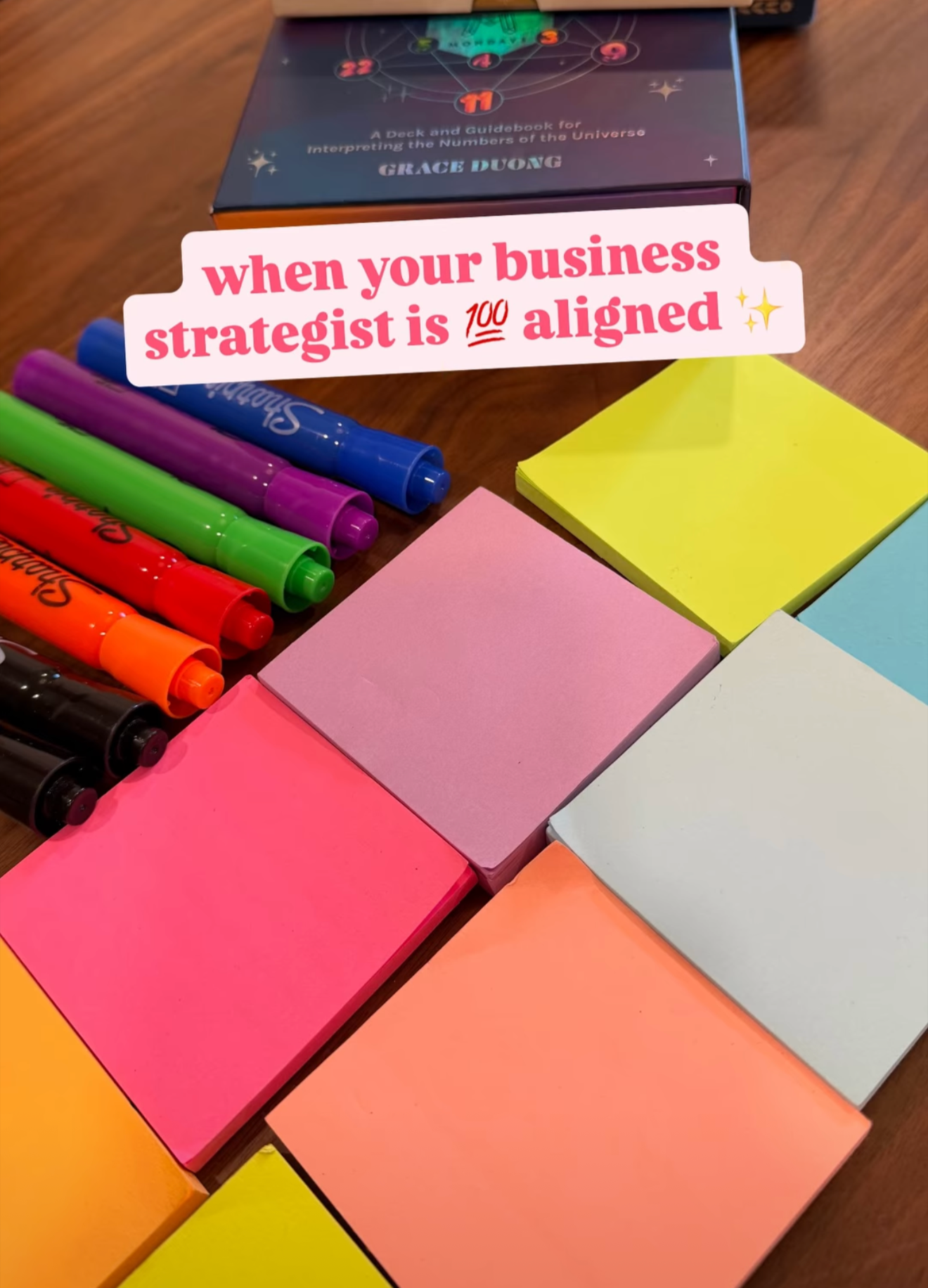
A client snapped a picture of the table after our strategy session and posted it with the caption, “when your business strategist is so aligned.”
And I just stared at it for a minute because, ten years ago, I was teaching yoga and deeply immersed in all of the woo-woo. I pulled cards, talked about energy, intuition, embodiment, all of it. I started learning how to read Tarot. Over time, as I moved deeper into business and leadership and operations, I think I slowly learned to make that part of myself less visible, or at least less central, because I had internalized some idea that serious business people were supposed to be a little less... whatever that was.
Turns out, “whatever that was” was… me.
So seeing that photo slapped me like a wet fish aka in a way I wasn’t expecting. Here I was, nearly two years after leaving a role that shaped so much of my professional identity, sitting in someone’s business with Post-it notes, oracle decks, strategy worksheets, markers, metrics, mission statements, and all the other things I love, helping her put language around what she already knew somewhere deep inside herself.
Because the work we were doing that day was actually pretty simple: we were taking things that already existed and making them visible.
At one point, she told me there was no structure in the business, and I was quick to remind her that I’m not building anything. I’m simply an archaeologist helping her unearth what is already there.
There were norms, traditions, behaviors, rituals, ways of communicating, ways of serving clients, ways of making decisions. The structure was there; it just hadn’t been made explicit yet.
Implicit systems work until they don’t. They work while everyone has enough shared history to know what is expected, while the founder is nearby to answer every question, and while the team is small enough to fill in the gaps for each other.
And then somebody goes on vacation, or gets sick, or the team grows, or one person leaves, and everyone discovers there were entire parts of the business living inside one person’s head.
3. Make your values prove themselves
I was working on a different version of this with another client this week: roles, responsibilities, milestones, KPIs and all the things someone is doing that nobody has ever actually named as part of their job.
Once we make all of that visible, we can do more than organize it.
We can question it.
Values work is very often something a company does so it can put a nice board on the wall. But the actual question is much less interesting and much more difficult: how do we know we’re living them?
If you say truth is a value, for example, but nothing is transparent, nobody knows how decisions are made, and your employees are afraid to ask questions, then truth is not really a value as much as it’s just branding.
And this is where I believe establishing, and living out, values can be as much a practice of saying what’s true as it is a practice of prefiguration.
Prefiguration, at its simplest, is the practice of building pieces of the world you want to live in now, rather than waiting for some future system to change around you.
I realize that talking about the values embedded in your employee handbook can feel a little quaint at a moment when the world itself feels tenuous at best. Depending on which corner of the internet you accidentally wandered into this week, AI is coming for all of our jobs, civilization is collapsing, we’re going to run out of something important, and there is probably a robot involved somehow.
I don’t know what happens next. None of us do.
But I think that uncertainty is part of why I care about this. I cannot redesign the enormous systems I live inside by myself, but I can pay attention to what I am practicing in the places where I actually have influence.
A business is one of those places.
4. Question “business as usual”
So much of what we call “business as usual” is simply inherited.
Someone did it this way before us. A consultant told us this was best practice. A boss taught us that this was what professionalism looked like. We read a management book and absorbed a norm, or copied a policy from someone we respected, and eventually what was borrowed but never examined became truth.
I’ve been thinking about this a lot because I’m currently reading Caste by Isabel Wilkerson for my Social System Transformation Theory class. I bought the book at least three years ago and never had the capacity to read it, which is one of the things I love about grad school: it gives me the accountability to pursue things I’ve wanted to pursue for myself but simply have not prioritized. At this particular moment I am apparently prioritizing some of those things over sleep, but that’s just the season I’m in.
The book is helping me understand my own relationship to systems differently, including how much of my twenties and thirties I spent trying to stay outside of the systems I distrusted, and the privilege embedded in believing I could simply opt out of them.
I have a LOT more to say about that and I think it is another essay.
But the part that belongs here is this: businesses do not somehow exist separately from the larger systems they were built inside of. Ideas about who gets authority, whose labor matters, who is expected to adapt, who receives information, and who gets to make the rules come into our workplaces with us.
Which is why I genuinely believe business can be liberatory, but not because the right employee handbook is going to dismantle oppression.
It’s because businesses are places where we practice relationships, power, responsibility, care, communication and decision-making every day. We have opportunities, sometimes very small ones, to decide whether we want to keep recreating what we inherited or try something else.
5. Decide what you actually want to practice
Which, I suppose, is where the newsletter story at the beginning was headed all along. The interesting part to me now isn’t who should have been writing the newsletter or what anyone should have been paid. It’s how something can move from being clearly defined, to being quietly absorbed, to becoming an expectation no one even remembers choosing. And there are a thousand versions of that happening in every workplace, all the time.
That, I think, is the part I care about most now.
Not simply documenting the business so it runs more efficiently, although yes, efficiency is useful. Not just helping a founder get things out of their head so someone else can take over. I want to help people see what they are actually asking of one another, what has become normal without ever being consciously chosen, and where the business they say they want to build is bumping up against the business they’re actually living inside.
Because once you can see it, you can do something with it.
And sometimes, you can realize that the thing you thought was “just how business works” is actually something you no longer believe in.
I want more giant pieces of paper on walls, more Post-it notes, more conversations with people who have already built something real and are ready to look at it closely enough to ask whether it still reflects who they are now.
I want to work with businesses that have history and habits and good intentions and weird little systems and things everyone “just knows,” because that is where there is actually something to unearth.
And I think, after nearly two years of asking myself what I wanted to do next, I finally have a much clearer answer:
I want to help people make the invisible visible, and then decide what they want to prefigure.
If you are looking at your business right now and thinking, there are things here we have never really named, and I’m not sure all of them still belong, I would love to talk.
xo,
Brittany